 Simulations With You
It was 6:30 AM last Tuesday morning, and I was feeling absolutely invincible. I had the whole day mapped out in my digital calendar with almost obsessive precision, color-coded and beautifully optimistic. Every single hour accounted for, every task assigned its own perfect little time slot. The blocks of time stacked perfectly like a winning game of Tetris—each piece fitting exactly where it should. There was the 7:00 AM gym session (blue block), the 9:00 AM creative sprint for that project I'd been putting off (green block), and the important 1:00 PM strategy meeting with colleagues (red block). My workout clothes were already laid out on the chair. My outfit was laid out, my work bag was packed with everything I needed, and honestly? I felt like the captain of my own destiny, steering confidently toward a productive, successful day.
I could practically hear the satisfying "click" sound in my mind as each piece of my perfectly planned day locked into place. It was going to be a symphony of productivity, a masterpiece of time management. I'd even built in a 15-minute buffer between tasks, just to be safe. Nothing could go wrong.
Then, gravity stepped in to conduct its own chaotic jazz solo. And gravity, as it turns out, doesn't care about your color-coded calendar.
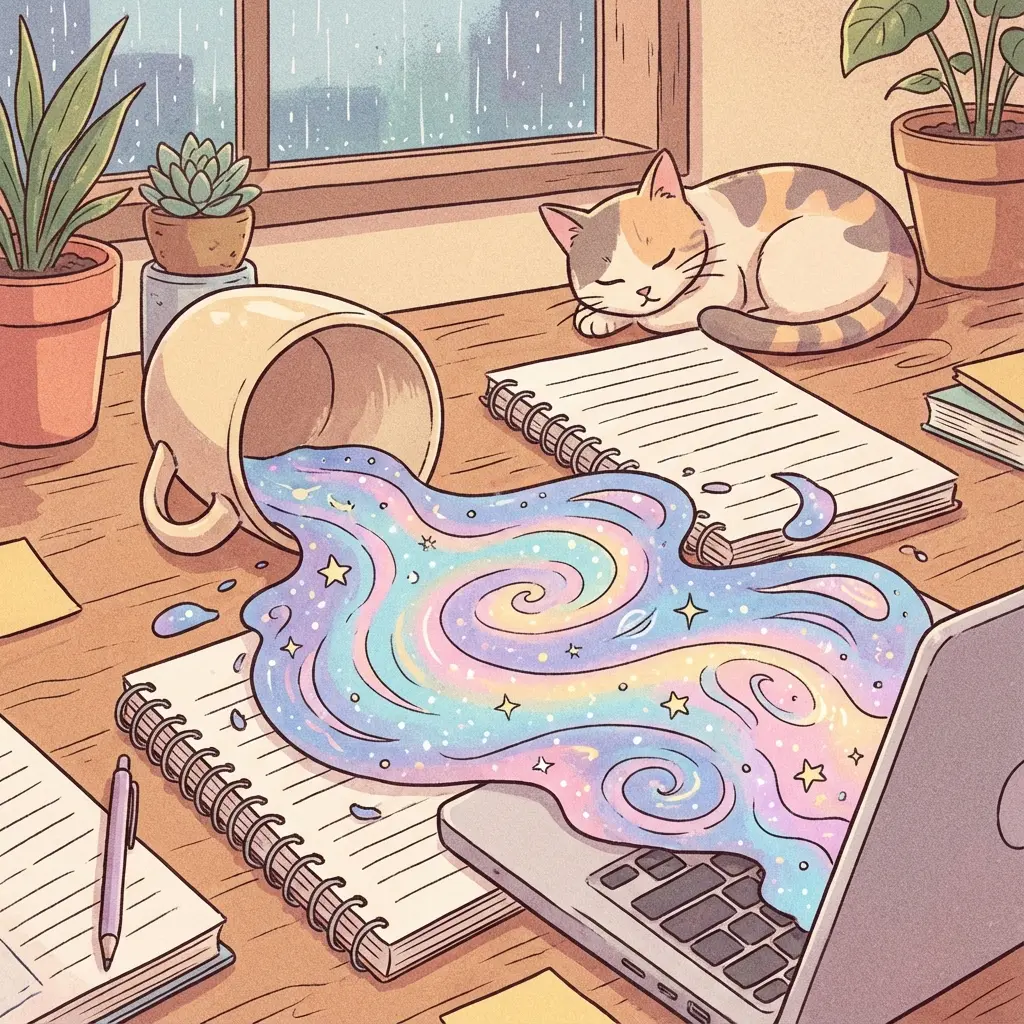
I reached for my coffee—a piping hot pour-over I'd just spent ten careful minutes meticulously brewing with my fancy new coffee maker, the kind with the precise temperature control—and my hand slipped. Maybe I was reaching too quickly. Maybe my brain was already three tasks ahead while my body was still on task one. Whatever the reason, time seemed to slow down in that horrible way it does when disaster is unfolding. I watched, completely helpless, as the full mug tipped over in what felt like slow motion. Physics took over—gravity pulled, liquid splashed, chaos erupted—and suddenly my perfect schedule was drowning in a rapidly spreading dark roast puddle. The coffee soaked into important papers on my desk. My laptop keyboard needed immediate drying with paper towels. The white shirt I was wearing—the crisp, professional one I'd picked out specifically for that afternoon meeting—needed changing. Now I had to find something else to wear. The perfectly timed 7:00 AM gym session evaporated as I frantically cleaned. The Tetris blocks came tumbling down, scattering across the imaginary floor of my ruined day, and there was absolutely nothing I could do to catch them.
The Illusion of Straight Lines
Here's something I've noticed about being human: we absolutely love straight lines. We love plans that march confidently from Point A to Point B without a single hitch, detour, or unexpected twist. We build our days like skyscrapers, stacking each hour floor by floor, block by block, expecting them to stand tall and rigid against whatever wind life throws at us. We fill our calendars with neat little rectangles and convince ourselves that if we just plan hard enough, organize thoroughly enough, prepare meticulously enough, we can eliminate the variable of "oops." We can control everything. We can make life obey our schedule.
But the universe? The universe has other ideas. It prefers curves over straight lines. It prefers bounces, spills, ricochets, and unexpected detours over predictable paths. From the swirling pattern of milk mixing into tea to the spiral arms of distant galaxies, from the way smoke curls upward to how rivers meander across landscapes, nature rarely moves in a straight line. It zigs when you expect it to zag. It spills when you expect it to sit still.
Standing there at my desk with a roll of paper towels in hand, frantically mopping up the spreading coffee puddle, cursing under my breath about my ruined morning, I paused for just a moment. I actually looked—really looked—at the mess I was cleaning. The spill had splattered outward into this fascinating, organic, almost fractal-like shape across the floor tiles, creating intricate patterns I could have never designed intentionally. In that moment of frustration, something shifted in my perspective. It wasn't a mistake in the cosmic sense; it was just physics doing exactly what physics does. Liquid following gravity, spreading according to surface tension, creating chaos from order. It was a perfect, unplanned demonstration of how things naturally fall apart—how order inevitably gives way to disorder, how tight control eventually loosens into beautiful, unpredictable mess.
A Different Kind of Pattern
My day was no longer perfect according to my original plan, but it was now genuinely interesting in ways I hadn't anticipated. Because I missed the carefully scheduled 7:00 AM gym session while cleaning up the spill, I had an unexpected gap in my morning. Later, feeling restless and needing caffeine to replace what I'd lost, I had to walk to a small neighborhood coffee shop I'd never tried before instead of just making more at home. And because I took that unplanned walk through streets I don't usually traverse, I saw a talented street musician playing an old acoustic guitar, performing a song I hadn't heard in years—a song that immediately transported me back to a happy memory I'd completely forgotten. The chaos wasn't a dead end that ruined everything; it was an unexpected door that opened to something new. It forced me out of my rigid, predetermined tunnel and into the open air where surprising, beautiful, unplanned things could actually happen.
Gravity Doesn't Judge
Here's what I realized while frantically dabbing at my coffee-stained shirt: we humans have this tendency to take it incredibly personally when things go wrong, as if the universe has singled us out for punishment. "Why is this happening to me?" we ask the ceiling dramatically, as if it might answer. "I organized everything so carefully! I planned every detail! I did everything right!" we protest to no one in particular. But here's the thing: gravity doesn't judge your organizational skills. It doesn't care about your important afternoon meeting or your pristine white shirt or your perfectly color-coded calendar. Gravity doesn't have opinions about your day. It just pulls. It's not personal. It's just physics being physics, doing what it's always done since the beginning of time.
There's a strange, deeply relieving comfort in realizing that "falling apart"—things breaking down, plans changing, order giving way to disorder—is a completely natural state of the universe, not some cosmic punishment designed specifically for you. Clouds break apart to release rain that nourishes the earth. Waves crash violently against the shore to create delicate foam and reshape coastlines. Even massive stars explode spectacularly at the end of their lives to create and scatter the carbon atoms that eventually make up you and me and everything we've ever touched. Things fall apart. Things change. Things refuse to stay in neat little boxes. If the entire universe is not just okay with chaos but actually requires it to function and evolve, maybe we can learn to be okay with it too. Maybe chaos isn't the enemy of a good life—maybe it's just part of the deal.
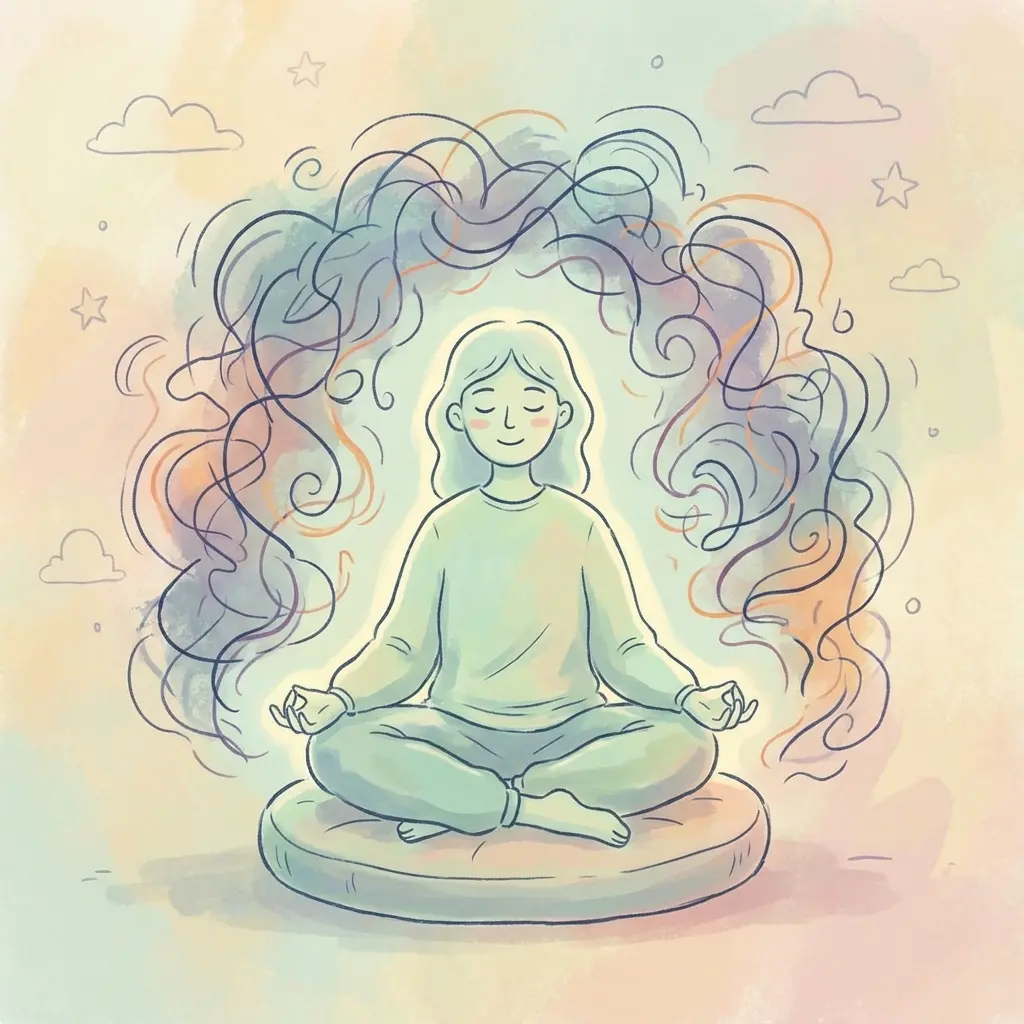
Instead of exhausting ourselves fighting against every unexpected fall, every spilled coffee, every disrupted plan, what if we just watched it happen with curiosity instead of panic? What if we treated the disruption not as a catastrophic failure that ruins everything, but as a surprise plot twist in the ongoing story of our day—one that might actually lead somewhere interesting if we let it?
Try This: The 5-Second Chaos Pause
The next time you drop something, spill something, or get cut off in traffic—when that familiar surge of frustration starts rising in your chest—try this tiny experiment instead of immediately spiraling into panic:
- Freeze: Don't react immediately with anger or stress (unless it's dangerous and requires immediate action, of course). Just pause. Take one breath.
- Observe: Look at the mess or the situation with genuine curiosity. Really look at it. Notice the shape of the spill, the pattern it makes, the unexpected paths things took. Notice the absurdity of the situation. If it's safe to do so, even smile at how ridiculous it all is.
- Reframe: Say to yourself, out loud or in your head, "Well, that's just how things fall apart sometimes." Or "Gravity wins again." Give it a name that removes the personal sting.
This tiny practice shifts your brain from "panic mode"—where everything feels like a catastrophe—to "observer mode," where you're watching an interesting event unfold rather than drowning in it. It turns a disaster into a scene in a movie you're watching rather than a tragedy you're starring in. And that shift in perspective? It makes all the difference.
🌌 Watch Gravity at Work
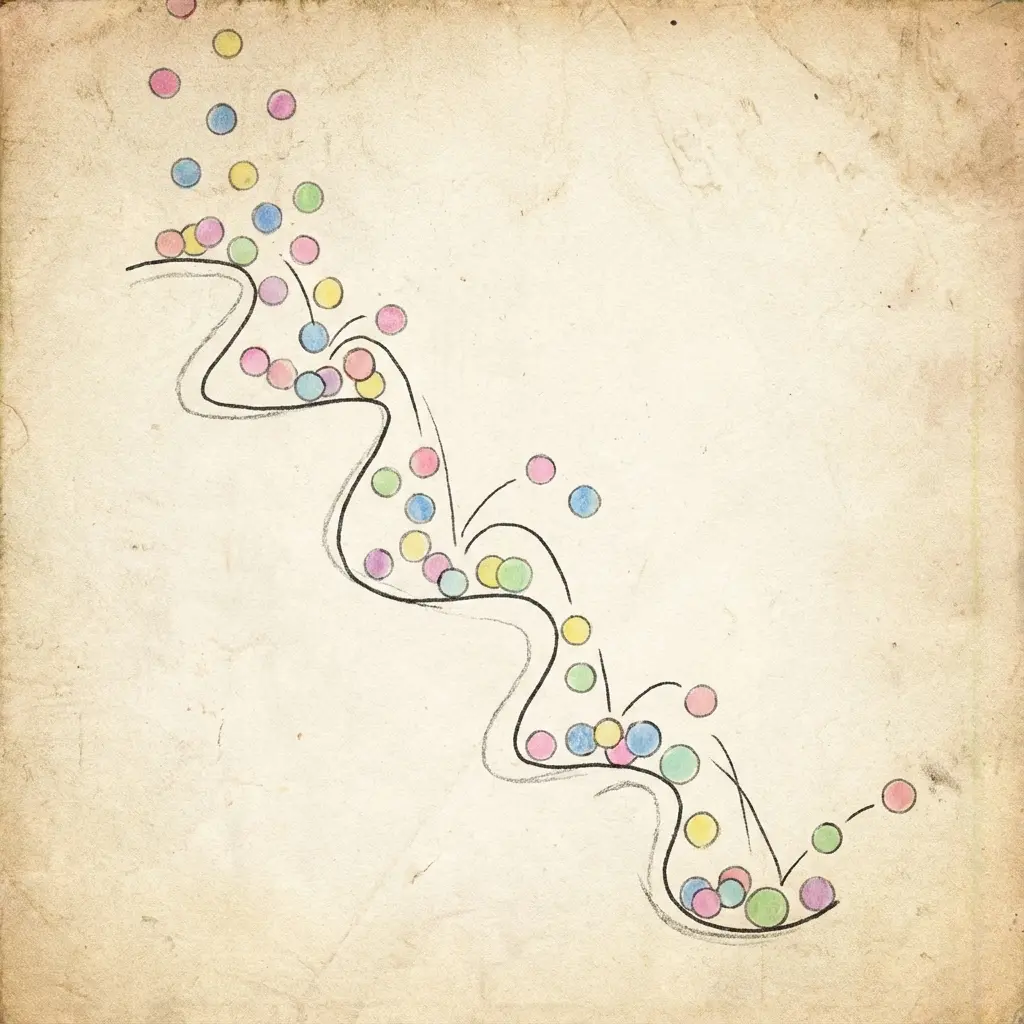
I created a simple interactive simulation inspired by that spilled coffee morning—a digital space where you can watch things fall apart in real time and see the unexpected beauty in chaos. Colorful particles fall, bounce off whatever obstacles you draw, and create their own unpredictable, beautiful mess across the screen. There's no winning, no losing, no "correct" outcome to achieve—just physics doing what physics does. Draw lines, watch things bounce and scatter, and embrace the gorgeous chaos that emerges. It's oddly calming.
Play Gravity Dots 🌌The Art of the Ricochet
In the Gravity Dots simulation, you can draw a line with your mouse or finger, trying to guide or stop the falling dots, attempting to impose some order on the chaos. But you'll notice something interesting happens: the dots don't just stop when they hit your line. They don't give up and disappear. They bounce. They ricochet at unexpected angles. They find completely new paths around the obstacle you carefully placed, paths you never could have predicted or planned.
And I think that's what real resilience looks like in everyday life. It's not about standing perfectly rigid and never falling, never making mistakes, never spilling coffee, never having plans disrupted. That's not resilience—that's just fragility disguised as strength. Real resilience is about the bounce—the recovery, the adaptation, the pivot. It's about how you move and what you do after the coffee spills all over your desk. It's about noticing and embracing the new trajectory that the universe has unexpectedly offered you, even if it wasn't in your original color-coded plan.
That Tuesday morning when my coffee spilled? My day did fall apart. My perfect schedule shattered. But you know what happened instead? I had that unexpected walk. I heard that street musician. I discovered a great new coffee shop. I arrived at my afternoon meeting wearing a different shirt, yes, but also carrying a story about chaos and adaptation that made my colleagues laugh. The day became memorable precisely because it fell apart.
So here's my invitation to you: next time your perfectly planned day falls apart—when the coffee spills, when the meeting runs late, when the train is delayed, when life refuses to follow your carefully drawn lines—don't exhaust yourself trying to force all the fractured pieces back together with stress and glue and frantic effort, desperately attempting to salvage the original plan. Instead, just pause. Look at the mess. Watch the pattern it makes as it unfolds. Notice where the pieces scatter. You might discover that the unplanned detour leads you somewhere more beautiful, more interesting, more memorable than the perfectly straight road ever could have. Sometimes the best moments in life are the ones that were never on the schedule at all.